Tuesday, August 14, 2012
Cyndi Lauper, Homeless Teens, and Libraries
Cyndi Lauper has started a new organization to help educate folks about the very serious problem about LGBTQ homeless teens. Why this group? Because "while LGBT kids make up an estimated three to five percent of the general population, they account for as much as 40 percent of the homeless youth population. The reason? Because families often abuse, neglect, and reject gay and transgender teens due to their sexual orientation or gender identity."
School and public librarians are not only in the perfect position to educate and get the word out about this problem—but they also offer LGBT teens a safe haven, says Greg Lewis, executive director of the True Colors Fund, which seeks to advance LGBT equality and was cofounded by Lauper. "There is much that the public and those who work directly with kids can do, especially librarians," he says. "For many young people who find themselves homeless, the local library is the only place where they can search the Internet for information and resources. For this very reason, libraries and librarians can play a major role in dispersing effective, sometimes life-saving information for homeless or at risk gay and transgender youth looking for help." Lewis says he encourages all librarians to familiarize themselves with the information and resources available on the Forty to None Project website, and to "urge any homeless or at risk gay and transgender youth who may visit their local or school library to seek help."
I encourage you to read through this site and be prepared for when you encounter this challenge in your community. Odds are, some of your teens may already be in this situation.
Wednesday, October 12, 2011
Should Libraries Offer Programs on Hacking?
License to Hack: Kids are getting into hacking in a whole new way. And that’s a good thing.
Workshops covered picking locks—the school locker variety—Google hacking, and coding in Scratch, a programming language for children. In a session entitled “Meet the Feds,” kids were invited to press the flesh with agents from the Department of Homeland Security and the National Security Agency and chat with them about “intelligence gathering, cyber weapons, war strategy, and more.”
It’s an interesting convergence, with the global exploits of hardcore hacker groups Anonymous and Lulzsec in the background, but hacking—in various forms—is another way in which kids are engaging technology and one that’s evolving.
What do you think? Is this the sort of thing libraries should be dipping our toes in? Is this how we get teens truly interested in new technologies, or is this getting into ethically dodgy ground?
Friday, April 22, 2011
Video Engagement, Beyond the Flip
So what sorts of things can libraries do with a video camera to promote all things teen? Social Media Examiner has a great article with lots of ideas that we can use: 26 Ways to Engage With Customers Using Video.
How can you see some of these ideas being used with teens at your library?
Tuesday, April 12, 2011
Social Networking Impact on Health Explored
"Pediatricians are adding another topic to their list of questions for visits with school-aged and adolescent patients: Are you on Facebook? Recognizing the increasing importance of all types of media in their young patients’ lives, pediatricians often hear from parents who are concerned about their children’s engagement with social media. To help address the many effects—both positive and negative—that social media use has on youth and families, the American Academy of Pediatrics (AAP) has issued a new clinical report, The Impact of Social Media Use on Children, Adolescents and Families in the April issue of Pediatrics (published online March 28). The report offers background on the latest research in this area, and recommendations on how pediatricians, parents and youth can successfully navigate this new mode of communication."
I like that it spells out benefits in addition to more worrying issues. Seems like sleep deprivation is becoming a national problem, eh? First time I've heard of "Facebook depression".Thursday, December 2, 2010
How Distracted Can Teens Get and Still Function?
Growing Up Digital, Wired for Distraction
By MATT RICHTEL
Published: November 21, 2010
As a distractable (yet pretty productive) person myself, I found this article very interesting.
Sam Crocker, Vishal’s closest friend, who has straight A’s but lower SAT scores than he would like, blames the Internet’s distractions for his inability to finish either of his two summer reading books. “I know I can read a book, but then I’m up and checking Facebook,” he says, adding: “Facebook is amazing because it feels like you’re doing something and you’re not doing anything. It’s the absence of doing something, but you feel gratified anyway.” He concludes: “My attention span is getting worse.”
And its not just the busy that seems to be the problem, but the effects of not getting true rest:
In that vein, recent imaging studies of people have found that major cross sections of the brain become surprisingly active during downtime. These brain studies suggest to researchers that periods of rest are critical in allowing the brain to synthesize information, make connections between ideas and even develop the sense of self. Researchers say these studies have particular implications for young people, whose brains have more trouble focusing and setting priorities. “Downtime is to the brain what sleep is to the body,” said Dr. Rich of Harvard Medical School. “But kids are in a constant mode of stimulation.”
If you want to see a great visual representation of how wired in teens are, watch the movie Easy A (I caught it at the Crest last night and thought it was the best teen movie I've seen in ages)...the gossip scene are a wonderful embodiment of the way teens have not just become wired in, but to each other.
Can they disconnect when they need to? Can you?
Friday, November 5, 2010
Top Myths About Marketing to Teens
9 Myths You Thought Were True
by David Trahan
There are some myths about marketing to teens that every marketer can learn from.
Myth #1: All teens want smartphones
Myth #2: Texting is the way in
Myth #3: Teens use Facebook the way we use Facebook
Myth #4: Teens are going to join Twitter
Myth #5: If you build it, teens will come
Myth #6: Teens are online all the time
Myth #7: Teens don't watch TV
Myth #8: Teen word-of-mouth happens online
Myth #9: Teens love online video
I found the article interesting for breaking down some "common knowledge" about teens, but also it is the first article I've seen separating teens from Millennials! I wonder what the generation following Millennials will be called?
Thursday, October 21, 2010
Successful Ongoing Gaming
I love how it focuses on the community that has evolved around teens who are fans of the program:
What we discovered after a month or two was the formation of a community.... Players encourage each other through the most challenging games and play in a good-natured way that encourages others to join in. We have a library full of engaged teen boys and our only real issues have been language and trash from our two vending machines.
Many of our teens ride the bus for at least an hour or more to get to the Central Library and they do it on an almost daily basis. They have learned to cooperate and participate with other teens from all over the city. Race, age, and ability have little to do with whether or not they can join a group playing. They teach each other and learn from each other daily.
I wish we could offer ongoing programming like this...sounds like a great idea!
Friday, October 15, 2010
Apple Tries to Censor Teen Sexting
Good luck trying to keep up with ever-mutating teenage slang; they will find a way to say naughty things, even it means subversively co-opting wholesome phrases. If anyone can turn something as benign-sounding as "I'm going to church to pray" into secret code for nefarious behavior, it's teenagers.
and
I can't help but think that parents' best bet in trying to protect their kids will be as it has always been: to communicate with them -- preferably face-to-face.
Bingo!
Of especial interest to teen librarians: "The average 13- to 17-year-old sends and receives 3,339 texts a month -- more than 100 per day." If we can't find a way to connect with teens at this level, will we disappear completely below their radar?
What do you think?
Thursday, September 23, 2010
Telling Teens It Gets Better
Here is Dan and Terry's:
Honestly, I think any struggling teen could benefit from hearing this message.
Please share with kids you know.
Friday, July 30, 2010
Hotels Join the Struggle to Captivate Teens
The Toughest Guest: a Teen
Hotels Try to Make Family Trips Fun; Mocktails Are OK, Dark Bonfires Aren't
By ANDREA PETERSEN
The key to attracting teens, some hotels say, is giving them grown-up experiences—and setting limits. When Atlantis did a focus group with 50 teenagers earlier this year to find out what they wanted in a new teen club, the participants asked for the oversized beds popular in some adult spots, hot tubs and "cages to dance in," says Amanda Felts, vice president of guest activities and resort planning. "That's not going to happen."
Much in this article reminds me of lessons libraries have already learned. Kids who enjoyed programs in their single digit years, won't necessarily just go along with programs aimed at teens. One kid saying the activity is stupid can drive out a whole crowd. And one cute girl can have the opposite effect. And bribery works ;)
Saturday, July 24, 2010
YALSA's President's Program - Free and Online
The part I find most exciting is what the guests from the Search Institute have to say about their new initiative focusing on Sparks. The 40 Developmental Assets talk about what kids and teens need to thrive, but this is about what next? How can we ignite the hidden talents and strengths of the teens we work with? What are those secret things they get excited about, but are scared to bring forth because no one believes in them? I think this could be a wonderful follow up action for our Teen Project. I'd love to hear what y'all think of it, too.
Wednesday, June 9, 2010
Interesting Article on Dystopian Fiction for Teens
Fresh Hell
What’s behind the boom in dystopian fiction for young readers?
by Laura Miller
The adult dystopia extrapolates from aspects of the present to show readers how terrible things will become if our deplorable behavior continues unchecked. The more utterly the protagonist is crushed, the more urgent and forceful the message. Because authors of children’s fiction are “reluctant to depict the extinction of hope within their stories,” Sambell writes, they equivocate when it comes to delivering a moral. Yes, our errors and delusions may lead to catastrophe, but if—as usually happens in dystopian novels for children—a new, better way of life can be assembled from the ruins would the apocalypse really be such a bad thing?
What are your thoughts? Favorites?
Our Post-Apocalyptic and Dystopian teen fiction list, created by Jocelyn.
Friday, May 28, 2010
Steampunk and Teens
Here is a panel from BEA with Scott Westerfeld, Cherie Priest and Cory Doctorow that explores "Steampunkery: Why are today's teens embracing 19th-century technologies?"
Steampunk Panel - SLJ Day of Dialog, BEA 2010 from School Library Journal on Vimeo.
What do you think? Are your teens into it?
Thursday, May 27, 2010
Adorable Teen Clique: Texas Werewolves
I'm amused that they claim they are not trying to get attention.
Any interesting groups evolving in your communities?
Tuesday, May 18, 2010
Second Guessing Social Networking
Antisocial Networking?
How Does Technology Affect Kids' Friendships?
By HILARY STOUT
Published: April 30, 2010
One of the concerns is that, unlike their parents — many of whom recall having intense childhood relationships with a bosom buddy with whom they would spend all their time and tell all their secrets — today’s youths may be missing out on experiences that help them develop empathy, understand emotional nuances and read social cues like facial expressions and body language. With children’s technical obsessions starting at ever-younger ages — even kindergartners will play side by side on laptops during play dates — their brains may eventually be rewired and those skills will fade further, some researchers believe.
What do you think? Should people be more concerned? Can libraries provide essential face time?
Wednesday, May 12, 2010
Teens Prefer Texting
American Teens Say Texting is Favorite Way to Communicate
In the past week, using its SMS text-messaging service, ChaCha asked nearly 1500 teen and young adult users: "What's your favorite way to communicate?" Their answers:
Mobile Text 67.53%
Mobile Call/Voice 9.22%
Facebook 8.84%
Instant Message 2.88%
Email 0.29%
*Other 11.24%
I find this pretty fascinating. I've heard for a while that teens found email "old fashion" (which pains me). I like email and still prefer it myself...though I do enjoy texting. Maybe we do need to reconsider how we communicate with teens. Though perhaps this is just preferred with peers? I'd be curious to see statistics on that.
Saturday, May 1, 2010
How Fast Are Teens Growing Up?
The Slow, Winding Path to Adulthood
By LISA BELKIN
Many a parent believes that their children are growing up too fast. Eight is the new 12, and 12 is the new 18. Today’s middle schoolers dress like adults, know how to swear like adults and are exposed to drugs. They also know about sex, talk back and reach puberty earlier than we ever did.
But then, they stop. And reverse. A study by researchers at Oregon State University, which appears this week in the journal Transition to Adulthood finds that “despite living in an age of iPads and hybrid cars, young Americans are more like the young adults of the early 1900s than the baby-boom generation: They are living at home longer, are financially insecure and are making lower wages.”
The gist of the article seems to be that there is no set or normal age for maturation within our culture or species, but it seems to have a lot to do with financial ability as much as anything.
How do you see this manifesting with teens in your life?
Tuesday, March 23, 2010
Legality of Teens as Sexual Beings
Today he posted a piece about the recent court decision that determined teens can not be tried for child pornography for sexting photos of themselves:
Court Finally Limits Persecution of Teen Sexuality
The good news is that our judiciary has finally told prosecutors enough is enough. A U.S. Appeals Court just upheld a preliminary injunction barring local prosecutors from filing felony child-porn charges against a teenage girl who took a topless photo of herself with her cellphone...
Hopefully none of this will effect us in libraries, but it is a very interesting part of the bigger picture of teen rights, development, and culture that is worth knowing about.
Monday, February 8, 2010
Great documentary on PBS: Digital Nation
Digital Nation: Life on the Virtual Frontier
Episode One: Distracted by Everything
Sound like anyone you know?
How might this effect the way we try and serve teens in libraries?
What do you think?
Thursday, February 4, 2010
What happens when we succeed?
Such as what Boston Public is currently experiencing at one of their great new branches:
Trouble touches an urban oasis
Struggling to keep peace at new Mattapan library
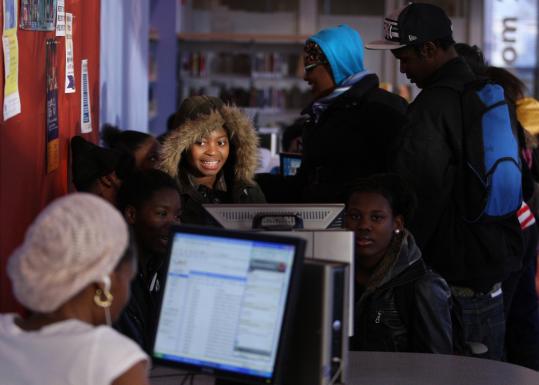
Mattapan residents spent more than a decade pushing for a public library in their neighborhood, to be an intellectual hub amid the nail salons and corner stores and to help occupy young people who might otherwise stray to the streets. Last year, they got their wish, a sparkling, $17-million glass-and-marble building with an abundance of books, learning materials, and programming.
But they also got an unexpected problem: throngs of young people who have daily overwhelmed the library’s staff of eight and created a hot spot for trouble. There have been fights, thefts, and a host of problems inside and outside its doors. Police have stepped up foot patrols in the area and had officers inside the building, but a library meant as a haven has instead become a worry for some parents.
Public officials give a lot of lip service to community services for teens, but do they really think about what success looks like? And what comes next once you have built it and they have come? If your library is full of teens, how do you manage it? If your library is picked as a Teen Center, how will you prepare for success?